


No products
Prices are shown in Polish złoty (PLN).
Choose your currency:
Prices in zloty - you can change the currency at any time at the top of the page.
- Classic Cubes
- Puzzles
- Pyraminx 132
- Megaminx 144
- Minx+ 42
- Skewb 93
- Square-1 37
- Clock 38
- FTO and CTO 19
- Mirror 64
- Gear 41
- Shape Mods 201
- Axis, Fisher and Windmill 43
- Ghost Cube 10
- Mixup 15
- Crazy and Bermuda 45
- Void & Bandaged 32
- Unusual Cubes 20
- Cuboids 78
- Pyramorphix/Mastermorphix 32
- Helicopter, Dino and Rex 33
- Polyhedra 102
- Snake 47
- Magic 3
- Rainbow Ball 8
- Klotski 22
- Brain Teasers 62
- Fidget Toys 24
- Shape Mods 37
- Picture Cubes 26
- Keychains 22
- Giant Cubes 37
- Mini 24
- Collectible Cubes 57
- Mosaic Cubes 13
- Cube Sets 29
- Other 2
- Smart Cubes & Electronic Puzzles
- Accessories
- Hobby
- Lubes
- Outlet


What Is a Fingerboard?
What is fingerboarding all about?
Fingerboarding is mainly about recreating skateboard tricks on a miniature skateboard called a fingerboard. Instead of your feet, you use your fingers (index and middle). The tricks are performed in much the same way, with a few small exceptions, such as grabs (basic grabs like the indy grab or nose grab are sometimes accepted on a fingerboard) or body rotations (on a fingerboard, spinning your whole hand more than 360 degrees is pretty rare). You can do tricks on the flat, meaning a flat surface, or on all kinds of obstacles, which are most often miniature versions of skateboard "ramps".

History
Miniature finger skateboards were already being made as homemade toys in the 1970s. They became more widely known in 1985 thanks to Powell-Peralta's video "Future Primitive", in which pro skater Lance Mountain rides a fingerboard around a sink. The real boom came in the late 1990s, when the Tech Deck brand entered the market and fingerboards reached toy stores all over the world.
How a fingerboard is built
Originally, fingerboards were, simply put, traditional skateboards on a small scale. Their length and width were proportional to the dimensions of regular skateboards (the deck most often measured 96 mm x 27 mm). Some of the first fingerboards were made by Tech Deck. The deck is the most important part of a fingerboard, and it often features a distinctive graphic that gives the board its charm. The deck, which was initially made of plastic, was covered with sandpaper (griptape). It made tricks easier to perform thanks to the extra grip. The next components are the trucks – the axles, initially made of plastic, fitted with plastic wheels (originally without bearings). The trucks contain bushings that let the fingerboard "turn" smoothly while riding. The trucks are attached to the deck with screws (mounting hardware), 4 per truck (8 in total).

Fingerboards then and now (comparison)
Over time, it turned out that making a fingerboard a perfect replica of a classic skateboard wasn't quite the right approach. Griptape was replaced by the foam tape that is commonly used today. The width of fingerboards has also evolved. It used to be about 27 mm; today it averages 32-34 mm (length also varies depending on personal preference). The concave (the curve of the deck) and the length and shape of the tail and nose have changed too. The angle of the tail and nose kick is also very important, because the wrong one can make tricks impossible. Plastic decks are now found only in budget fingerboards for beginners. Today, wooden decks made of several layers of plywood dominate (occasionally the bottom layer is made of metal). The trucks of professional fingerboards are now made of metal (and matched in width to the decks). The truck nuts that hold the wheels in place now usually have special locking features that stop the wheels from coming loose on their own (so-called lock nuts). Wheels are made much more carefully and have bearings (most often single-bearing wheels, but you can also find dual-bearing ones). Their shape, colour, "hardness" and material also depend on preference (polyurethane wheels have recently become very popular). Graphics are also applied to fingerboards differently. Plastic fingerboards used to simply have a printed design. Today, boards with "peel-off" graphics are popular, which makes them look very realistic. Many brands also make decks with unique, hand-applied graphics. Other ways of decorating decks include wood burning or creating so-called splits (the bottom layer of the deck is divided into pieces of different colours). An additional component is boardslides (also called sliders). They are screwed onto the underside of the board so it slides better on obstacles. They matter more on a skateboard, so on fingerboards they are often purely decorative. All fingerboards, just like skateboards, are compatible with each other (sometimes the trucks may not match the width of the deck, for example, but you can still put them together). This means that the dimensions of the screws, the holes in the decks, etc. are the same in every FB (there are occasional exceptions, e.g. certain wheels fit only certain trucks, but they can often be modified).
Obstacles
Ledges, rails, quarter pipes, kickers, pole jams, mini ramps, curbs, stairs, hubbas – everything you need for skateboarding exists in the world of fingerboarding. Scaled-down versions of existing spots, as well as brand-new obstacles, are everywhere in fingerboarding. The basics, however, are a grind box (ledge), a kicker, a rail and a quarter pipe. There are also larger setups to ride, known as fingerparks. For the average user, though, they are quite expensive (prices go up to several thousand złoty). This is because they are usually handmade. Many people therefore decide to build their own obstacles. They used to be made of plastic (hardly used anymore); today they are made of plywood (with metal angle edging), concrete or granite (and marble too).

Is fingerboarding only about pulling off the best tricks?
Short answer: no. In fingerboarding, it's not just about landing "the best trick possible". Flow matters a lot too, as do landing properly on the board, height, the length of the run-up and many other factors. Everyone has their own way of doing a trick, and even when doing the same trick, everyone has their own "style". Some prefer to do tricks low to the ground, while others like to catch them high in the air. Everyone also has their favourite tricks. Fingerboarding also means meeting new people, a piece of skateboarding culture and the adrenaline of competitions, which are held too. For many people it's a way of expressing themselves, and this hobby can often be treated as an art form. Some people paint on paper or canvas, others on fingerboards or obstacles. Many people also collect fingerboard decks. Some of them are already highly valued and sought after.
Prices
Fingerboard prices start at a few złoty (plastic ones) and go up to several hundred. A mid-range fingerboard will cost you around 50-100 zł. If you want higher-end gear, expect to spend from 150 (second-hand) up to 400-600 złoty. On top of that, there's the cost of ramps, which also range from about 50-500 zł each and even several thousand for a complete fingerpark (e.g. Blackriver Ramps). That's why many people decide to make their own. Some collectible decks sell for over $500 each (WOOB fingerboards).
As you can see, fingerboarding is a really interesting way to spend your time. If you'd like to learn more about this unusual hobby, join the fingerboarding group on Facebook.
Article written by Mateusz Początek
In the Fingerboard category, you'll find boards, sets with ramps and accessories.

Related products
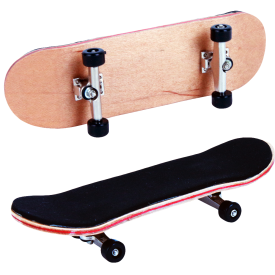
Fingerboard Pro + Case
Price: 40,99 złA fingerboard with a 5-ply maple deck, wheels with sealed bearings and a...
Fingerboard + Mini Skatepark
Price: 68,99 złYJ fingerboarding set: 2 fingerboards, approx. 9 cm long, with rough grip on...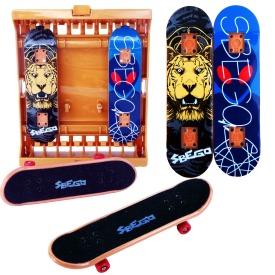
SBEGO Fingerboard Set 3 Pieces + Board Stand...
Price: 21,99 złThe SBEGO set includes a complete fingerboard (approx. 9 cm, 1:8 scale), 2...
Leave a comment
Related posts
-
 How to Learn Cube Algorithms Faster: A Research-Based GuideHow do you learn PLL and OLL algorithms effectively, train for speedcubing and memorize for blindfolded solving? A...
- How to Lube a Speed Cube: The Complete Guide to Cube LubesEverything about lubing cubes: a 2-minute lubing method for beginners, the history of lubes since 1980, the chemistry...
- Boys' Day Gift GuideWhat to buy for Boys' Day? Gift ideas: 3x3 and 4x4 cubes, Megaminx, Pyraminx, Mirror Cube and a pen spinning pen,...