


Before you start
3x3 Fewest Moves (FMC for short, officially “3x3x3 Fewest Moves”) is the only WCA event in which solving time is not measured. Everyone gets the same scramble and has an hour to find the shortest possible solution and write it down on paper. The result is the number of moves. You don't need to solve fast - what counts is ingenuity.
What you need to know
- how to solve a 3x3 cube with any method,
- how to read and write moves (R, U', F2…) - if you don't know the notation yet, have a look at the 3x3 beginner course.
How many moves
The beginner's layer-by-layer method usually needs over 100 moves, and CFOP, which most fast competitors use, about 55-60. In FMC you don't solve with a fixed method; instead you look for short pieces that happen to fit this particular scramble. That's how people get down to 30-40 moves, and the best to about 20. The world record for a single attempt is 16 moves, and for the mean of three attempts 19.00 (as of October 2026).
How to hold the cube
Throughout the course the cube is held with the white centre on top and green in front - the same as when scrambling at competitions. Don't rotate the whole cube while looking for a solution: that way you write every move down straight away exactly as it will appear on the sheet. The solve can end with any colours on any faces, but the centres don't move, so it will always end with white on top.
1Event rules
Goal: you know how an FMC attempt goes and what can get you a DNF.
The FMC rules are described in Article E of the WCA Regulations. The most important points (the numbers in brackets are regulation numbers):
How an attempt goes
- The judge hands out the scramble and the paper, starts the timer and says “GO” (E2a). Before the start you may not write anything on the attempt paper other than your details, or show the scramble to anyone.
- You have 60 minutes (E2b). After 55 minutes the judge usually says “5 MINUTES REMAINING”, and after 60 - “STOP”. You may hand in your solution earlier.
- You hand in one sheet with the solution and details that identify the attempt: your full name, WCA ID or competitor number (E2c1). A sheet without these details is a DNF.
- The solution is correct if a solved cube, after applying the scramble and then your solution, is solved again (E2c).
- Throughout the attempt you may not talk to anyone except the judge and the WCA Delegate (E5).
What you may have with you
- paper and the solution sheet from the judge, plus the picture of the scrambled cube if one comes with the scramble,
- pens or pencils (they can be your own) and something to correct with: an eraser, correction fluid,
- up to three of your own 3x3 cubes - on one you look for the solution, on the second you can keep the scrambled state, on the third you check what you've written,
- stickers (your own) - useful for marking pieces, e.g. for insertions (stage 7),
- a watch or timer to keep track of time, if the Delegate agrees (without functions that help find a solution).
During the attempt you may not use devices with the screen on (e.g. a phone), headphones or your own notes with algorithms or commutators (2i2) - everything you learn has to be in your head.
Result and formats
The result is the number of moves in the solution (E2d) - exactly as you wrote it, counted in the OBTM metric (details in the next stage). FMC rounds are held as (9b4):
- Best of 1 or Best of 2 - the best attempt counts,
- Mean of 3 - three attempts (usually at different times of the day), the mean of all three counts, e.g. 31, 28 and 34 give 31.00. One DNF means a DNF for the whole mean (9f11).
With equal means, the best single attempt decides (9f14). Usually all competitors get the same scramble in a given attempt. After handing in your sheet you can take a photo of the scramble and talk about it with people who have also finished.
What gets a DNF
- the solution doesn't solve the cube,
- no competitor details on the sheet,
- ambiguous notation: several solutions without one being indicated, asterisks and arrows saying “insert this bit here”, a letter that could be B or R (E2c2). Minor corrections are fine: a crossed-out move with a new one above it. It's best to draw one box around the whole solution and clearly cross out everything else (E2c3),
- a move outside WCA notation, e.g. M (stage 2),
- more than 80 moves including whole-cube rotations (E2d1),
- a solution derived from the scramble (E2e) - e.g. one starting with the same 4 or more moves as the scramble read backwards. The Delegate may ask you to explain the purpose of every move.
The scramble
FMC scrambles from the WCA program start and end with the moves R' U' F. This way the last moves of the scramble give nothing away and don't cancel with the start of the solution. The middle of the scramble leads to a random cube state. This is the scramble on which we'll show a whole example solution:
R' U' F R L U L' U2 L2 D F' B2 D' L D R U2 R U' L2 F2 D2 R' U' F
2Notation and move counting
Goal: you write your solution so that the judge has no doubts, and you know how many moves they will count.
In the solution you may only use moves from WCA notation for the 3x3 cube (Regulation 12a), and each move counts separately, exactly as written. Moves are counted in the OBTM metric: a turn of one face or of two outer layers is one move, a rotation of the whole cube is zero moves.
| Notation | Moves | Notes |
|---|---|---|
| R R' R2 | 1 | R2 is also one move. The judge will read R2' as R2. |
| Rw Rw' Rw2 | 1 | a face together with the middle layer; you can also write 2Rw |
| x y z | 0 | whole-cube rotations; they don't increase the result, but they count towards the 80-move limit |
| R R | 2 | written separately, they count separately - combine them into R2 |
| M E S | - | not allowed (DNF). Instead of M write R L' x' - that's 2 moves |
| r | 1 | a lowercase letter does not mean two layers here - the judge will read it as R. Two layers is always Rw |
The judge only takes letters, digits and apostrophes into account and ignores all other characters - so a bracket like (R U)' will be read as R U', not as the inverse of the whole bracket. Always write the moves in order, each one separately.
No rotations
Rotations x, y, z cost nothing, but in FMC almost nobody writes them down. Every move after a rotation can be written as a different face without the rotation, and keeping the cube in the same orientation all the time (white on top, green in front) protects you from mistakes when copying. Two-layer moves are rarely needed either: Rw is the same as L plus an x rotation, so a move of the opposite face is usually enough.
Check your solution like a judge
Enter the scramble and the solution, and the checker will read them according to the WCA Regulations: it will count the moves, show how it understood the notation and tell you whether the cube is solved. Try, for example, adding M, a lowercase r or R R and see what happens.
3How to look for short solutions
Goal: you understand how searching in FMC differs from speedsolving.
When speedsolving you go through known steps in a fixed order. In FMC you have an hour, so you can try many starts and pick the shortest. A few principles that work from your very first attempt:
- Build blocks, not layers. A finished piece of the cube (e.g. a 2x2x2) can be extended further without disturbing it. Layer by layer costs many more moves, because every new piece has to be brought in without breaking the whole layer.
- Colour doesn't matter. A block can be built around any of the 8 corners, and the “first layer” can be on any face. Look where the pieces already fit together.
- Use what is already there. A corner and an edge that already sit next to each other, correctly matched, form a pair - such pairs are the cheapest start for a block.
- Write everything down. Write every idea down immediately with its move count. You'll often find the best start only after several tries, and you need to be able to go back to it.
- Avoid long algorithms at the end. OLL and PLL together are a dozen or so, and sometimes over 20 moves. It's better to leave a few pieces unsolved and add a short insertion to the solution (stages 6-7).
- Look for cancellations. When one piece ends with R and the next one starts with R, you write R2 and save a move. When it ends with R and the next starts with R', both disappear.
The plan we teach is: 2x2x2 block → 2x2x3 block → two layers minus one slot (F2L-1) → skeleton → insertion. We'll show it step by step on the single scramble from the previous stage. The finished solution is 26 moves.
42x2x2 block
Goal: you build any 2x2x2 block in 4-7 moves.
A 2x2x2 block is one corner, the three edges next to it and three centres - one eighth of the cube, solved together. There are 8 such places on the cube (one at each corner), and every one of them is fine. The shortest possible block usually takes 4-6 moves, most often 5.
How to look
- Look over the cube and find pairs: a corner with a matching edge, or an edge next to its centre.
- Choose the corner with the most such ready-made bits next to it, and count how many moves you need for the remaining pieces.
- Check several corners, write each idea down. When you have 2-3 options, pick the shortest - or one after which the block is easy to extend.
In the example scramble, the pieces of the block at the white-green-orange corner (UFL) are close together. 3 moves are enough:
Such a short block is rare - it's the luck of this scramble. Usually you need 5-6 moves, and that's a good result.
Free faces
Once the block is done, three faces of the cube don't touch it - for the UFL block these are R, D and B. Their moves are “free”: they don't break the block, so you can use them freely to position further pieces. With a move of a face that touches the block you can also break it for a moment, as long as you undo it afterwards.
52x2x3 block and F2L-1
Goal: you extend the block to two layers minus one slot.
2x2x3 block
A 2x2x3 block is a 2x2x2 block extended by a corner and two edges - along one of the block's three edges. So every 2x2x2 block can be extended in three directions: check all three and pick the shortest. The extension usually takes 4-7 moves.
In the example we add the UFR corner and the UR and FR edges. The moves U' and U move the block away for a moment and then put it back, and the remaining moves are free faces.
F2L-1
F2L-1 is the first two layers minus one slot (a corner and the edge above it). A 2x2x3 block is already almost half of it: what's missing is a second 2x2x2 block next to it, minus one corner. These two layers don't have to be on the bottom at all - in the example they are the F face and the middle layer behind it, and the “last layer” will be the B face.
With a 2x2x3 block only two free faces are left (D and B in the example), so now you move the block away and back more often. Leave the missing slot for later - it often solves itself during the next step.
After three steps we have 16 moves and two layers almost done. For comparison: in CFOP the cross and three pairs are usually about 30 moves.
6Skeleton
Goal: you finish the solution so that only three unsolved corners are left.
After F2L-1, the last slot and the last layer remain. You can solve them with algorithms, but that's expensive: the slot plus OLL and PLL easily add up to 25-30 moves. In FMC you do it differently: you look for a short ending after which almost everything is solved and, say, three corners are left in the wrong places. Such an almost-finished solution is a skeleton.
Three corners are left because there are short insertions for them (stage 7), which are added into the middle of the skeleton. An insertion often partly cancels with the moves of the skeleton and costs fewer than 8 moves, while finishing with algorithms costs far more.
How to look for a skeleton
- First take care of the edges: the last slot and the last-layer edges. The corners can stay unsolved.
- Check several ways of inserting the last pair and see how many corners are left wrong. Three is a good result; two swapped corners or two twisted ones can also be fixed with an insertion, but that's a topic for later.
- If many pieces are left, go back a step - a different slot or a different 2x2x3 block may give a better ending.
In the example the ending is 8 moves: it inserts the edge of the last slot and solves all the edges of the B face. Three corners are left: DFL (from the last slot), DBL and UBR.
Cancellations between steps
Step 3 ends with the moves B' R, and step 4 starts with R' B'. R and R' cancel, and the two B' moves give B2. Of 3 + 6 + 7 + 8 = 24 moves, 21 remain:
U2 D2 L' B2 U' D B' U R' D R' U' B2 U B2 R B' D2 L' D2 L
7Insertion: corner commutator
Goal: you can add to the skeleton an 8-move commutator that cycles three corners, and find the spot where it cancels.
The commutator
A commutator is the sequence A X A' X': do A, then X, undo A and undo X. When A and X barely touch each other, most of the moves cancel out and only three pieces change. For corners the simplest recipe is:
- X - a turn of one layer (e.g. D),
- A - three moves that swap exactly one corner in that layer for a corner from outside it, without touching the rest of the layer (e.g. R U R' - it takes the DFR corner away and puts a corner from the top in its place).
Together: R U R' + D + R U' R' + D'. It cycles three corners: two from the D layer and one from the top, and the whole rest of the cube stays solved.
By changing X (D, D' or D2) and A (R U R', R U' R' or R U2 R') you get different triples of corners and different directions of the cycle. To begin with, it's enough that you can build such a commutator when you need it. If the three corners don't fit any 8-move commutator, set them up with one move (sometimes two), do the commutator and undo the setup - just like in blindfolded solving. Such an insertion is 10-12 moves before cancellations.
Where to insert
A commutator can be added anywhere in the skeleton: between any two moves, at the start or at the end. You then have to track the pieces as they lie at that point:
- Mark the three unsolved corners - e.g. with small stickers (they are allowed at competitions precisely for this).
- Scramble the cube again and perform the skeleton move by move. After each move check where the marked corners are and whether you know a commutator that would cycle them at that point.
- Choose the spot where the commutator cancels the most with the neighbouring moves of the skeleton - e.g. it starts or ends with a move of the same face as the neighbouring move.
In the example the best spot is after the second move of the skeleton, after U2 D2. The three marked corners happen to be at DBL, UBL and DFR there - exactly where the commutator B R' B' L' B R B' L works.
The insertion ends with L, and the skeleton continues with L' - they cancel. After them, B' from the commutator and B2 from the skeleton give B. Of 21 + 8 = 29 moves, 26 remain:
U2 D2 [B R' B' L' B R B' L] L' B2 U' D B' U R' D R' U' B2 U B2 R B' D2 L' D2 L
U2 D2 B R' B' L' B R B U' D B' U R' D R' U' B2 U B2 R B' D2 L' D2 L
8Inverse scramble (NISS)
Goal: you can look for the start of a solution on the inverse scramble and transfer it to the normal one.
The inverse scramble is the scramble read backwards, with every move in the opposite direction. It has an important property: if you solve the inverse scramble, that solution read backwards (each move inverted) solves the normal scramble - and has the same number of moves. The inverse scramble is a completely different cube, so you get a second chance at a good block. The technique of switching between them is called NISS (Normal-Inverse Scramble Switch).
This is not deriving a solution from the scramble: the inverse scramble itself still has to be solved. You just may not hand in a solution that starts the same way as the inverse scramble.
Example
On this scramble the shortest 2x2x2 block takes 5 moves:
R' U' F R' F2 R' F2 L F D' L' D F2 D B2 U2 F2 D F' R2 L F2 R' U' F
The inverse scramble looks like this:
F' U R F2 L' R2 F D' F2 U2 B2 D' F2 D' L D F' L' F2 R F2 R F' U R
and on it a 2x2x2 block appears in two moves:
Moves before the scramble (premoves)
How do you take this block back to the normal scramble? You invert the moves found on the inverse scramble (U2 R' → R U2) and treat them as premoves: on a solved cube you first do R U2, and only then the normal scramble. On such a cube the 2x2x2 block is ready straight away:
From here you search normally: 2x2x3, F2L-1, skeleton. Once you have the rest of the solution, you add the premoves at its end: the whole solution is the rest + R U2. Nothing gets lost: the two moves from the inverse scramble go to the end of the solution of the normal scramble.
In this example the rest (2x2x3 block, F2L-1, skeleton and insertion - just like in stages 5-7) is 24 moves, and with R U2 added the whole solution is 26 moves:
U2 L2 B2 F' U B2 U' F U L' B U2 F' L F L D L B2 R D2 R' B2 D' R U2
The same trick works in both directions and at any time: you can start on the normal scramble, switch to the inverse when you get stuck, and keep collecting premoves. To begin with, it's enough to look for a 2x2x2 block on both scrambles in every attempt and pick the better one.
9Your first attempt: 60 minutes
Goal: you hand in a correct solution within 60 minutes.
A plan for the hour
- Minutes 0-15: the start. Look for a 2x2x2 block at different corners, on the normal and the inverse scramble. Write down the 2-3 best ideas with their move counts.
- Minutes 15-35: extension and skeleton. Develop the best starts into F2L-1 and a skeleton. When one gets stuck, go back to another.
- Minutes 35-50: insertion. For the best skeleton, look for a spot for a commutator.
- Minutes 50-60: copying and checking. Copy the solution neatly onto the sheet, count the moves, then scramble a second cube and perform on it exactly what's on the sheet.
Always have a backup solution. If you have nothing after 40 minutes, solve the cube with any method, writing down every move - even a 70-move solution is better than a DNF, especially in a mean of three attempts. Just remember the 80-move limit.
A competition-style attempt
A random scramble in FMC format and 60 minutes, just like at a competition: after 55 minutes you'll get a warning, and after 60 the solution will be handed in automatically. Search on a real cube, type your solution in the field below (it's saved in the browser, so refreshing the page won't erase it) and submit it for checking.
At competitions the middle of the scramble leads to a random cube state from the WCA program, while here it's a random sequence of moves - for learning purposes this makes no difference.
Cheat sheet
The most important rules and techniques from the course on one sheet.
Printable cheat sheet (A4 / PDF)
- Rules - 60 minutes, one sheet with your competitor details, the solution must solve the cube after the scramble, at most 80 moves including rotations. Up to 3 of your own cubes and stickers.
- Counting - R, R2, R', Rw = 1 move; x, y, z = 0. No M, E, S; r = R.
- Start - a 2x2x2 block at any of the 8 corners, on the normal and the inverse scramble.
- Extension - 2x2x3 in one of three directions, then F2L-1; free faces don't break the block.
- Skeleton - all edges solved, 3 corners left.
- Insertion - commutator A X A' X', e.g. R U R' D R U' R' D', at the spot where it cancels the most.
- NISS - a solution of the inverse scramble read backwards solves the normal one; moves from the inverse = premoves, added at the end.
Practise in the simulator
A scramble in FMC format and a move counter that works like the judge's: consecutive moves of the same face merge (R R = R2 is one move), cube rotations don't count, and a middle-layer move counts as two. Choose the 2x2x2 block exercise - once you've built it, you'll see the shortest possible block for that scramble. You can also practise the 2x2x3 block and F2L-1, or solve the whole cube.
Drag a sticker with your finger or mouse to turn a layer, or drag outside the cube to rotate the view. Keyboard: R, L, U, D, F, B, with Shift for the opposite direction; X, Y, Z rotate the whole cube.
Common problems
The solution on the sheet doesn't solve the cube
Most often it's a copying mistake: a skipped or swapped move, a missing apostrophe, R instead of R2. Before handing it in, always scramble a second cube and perform on it exactly what's on the sheet - that's exactly why you're allowed three cubes.
After the insertion more pieces fell apart
The commutator was done in the wrong direction or at the wrong spot in the skeleton. Check that at the insertion point the three marked corners are where the commutator works, and that they cycle in the right direction. If not, try the same commutator inverted (X A X' A').
I can't find a good block
Check the inverse scramble and all 8 corners. Practise the “2x2x2 block” mode in the simulator - after each solve you'll see the shortest block, and over time you'll start spotting it yourself.
I'm running out of time
Stick to the plan for the hour and write down a backup solution by minute 40 at the latest. Leave the last 10 minutes for copying and checking.
The moves in the copied solution are different from those on the cube
Usually that's a whole-cube rotation during the search. Keep the cube with white on top and green in front all the time, and when you want to look at the back - rotate it, look, and return to the orientation before the next move.
The judge counts more moves than I thought
The judge counts the moves as written: R R is two moves, and R L' x' instead of M is also two. Combine neighbouring moves of the same face before you copy the solution out neatly. The “Check your solution like a judge” tool in stage 2 will show you such spots.
What next?
With blocks, a skeleton and one insertion you'll get below 40 moves, and with practice to around 30. The best competitors also use:
- edge orientation (EO) - at the start they orient the edges so that they can then be solved without F and B moves, which makes building blocks much easier,
- edge insertions and double insertions - a skeleton can leave e.g. 5 corners or 3 edges and 3 corners, and two insertions cancel even better,
- full NISS - switching between the normal and the inverse scramble many times within one solution,
- domino reduction (DR) - the method the best use to get to 20 moves and fewer.
All of this is covered in detail in Sebastiano Tronto's free book “Fewest Moves Tutorial” - the author is one of the world's top FMC solvers. The event is held at some WCA competitions in Poland; one attempt takes an hour, so a Mean of 3 round is usually spread over a whole day or a whole weekend.
If you enjoyed planning rather than fast fingers, also try blindfolded solving - commutators and setups from insertions are just as useful there.
Cubes for fewest moves
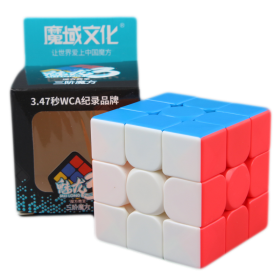
You can bring up to three of your own cubes to a competition. They don't have to be fast - what matters is that they turn well and don't pop or skip, because you check your solution on them.



Other courses
- 2x2x2 Cube How to Solve a 2x2 Cube - Step-by-Step Course The simplest way to solve the 2x2 cube: white layer, yellow face and corners into place. 3 algorithms are enough - you know two of them from the 3x3 course. Go to the course
- 3x3x3 Cube How to Solve a Rubik's Cube 3x3 - Step-by-Step Course The layer-by-layer method from scratch: daisy, white cross, the first two layers and the last layer. Every move on an animated cube. Go to the course
- 4x4x4 Cube How to Solve a 4x4 Cube - Step-by-Step Course The 4x4 cube with the reduction method: you solve the centres and pair up the edges, then finish it like a 3x3. Plus 4 new algorithms, including two parities. Go to the course
- 5x5x5 Cube How to Solve a 5x5 Cube - Step-by-Step Course The 5x5 cube with the reduction method: you solve the centres and pair up the edges, then finish it like a 3x3. The face colours are set by the centres, and at most one parity awaits you at the end. Go to the course
- 6x6x6 Cube How to Solve a 6x6 Cube - Step-by-Step Course The 6x6 cube with the reduction method for those who already know the 4x4 and 5x5: four kinds of centre pieces, edges made of four wings, and parities. We focus on what is new. Go to the course
- 7x7x7 Cube How to Solve a 7x7 Cube - Step-by-Step Course The 7x7 cube with the reduction method for those who already know the 5x5: six types of centre pieces, edges made of five pieces and two edge parities. At the end, rules for the 9x9 and bigger. Go to the course
- Pyraminx How to Solve a Pyraminx - Step-by-Step Course The pyramid in 4 stages: tips, centres, bottom layer and the last three edges. 3 short algorithms are enough - it is the easiest puzzle of the whole family. Go to the course
- Megaminx How to Solve a Megaminx - Step-by-Step Course A dodecahedron with 12 faces is solved like a 3x3 cube, it just takes longer: layer by layer, with the same algorithms. The course guides you through every step, including the middle belt, where most people get lost. Go to the course
- Skewb How to Solve a Skewb - Step-by-Step Course The cube that turns along its diagonals: the white face from an insertion table, then the bottom corners and the centres. Four short algorithms. Go to the course
- Square-1 How to Solve a Square-1 - Step-by-Step Course A puzzle that changes shape. First you will learn to bring it back to a cube shape (with clear rules instead of guessing), and then solve the colours layer by layer - parity included. Go to the course
- FTO How to Solve the FTO - Step-by-Step Course An octahedron that becomes an official WCA event in 2027. Edges first, then corners, triangles at the end - six short algorithms. Go to the course
- Clock How to Solve a Clock - Step-by-Step Course A puzzle with 18 clocks, 4 pins and 4 wheels. There are no algorithms to memorise here - three rules are enough, and the whole solve takes a dozen or so moves. Go to the course
- 3x3x3 One-Handed How to Solve a 3x3 Cube One-Handed - Step-by-Step Course What the One-Handed event is about, which hand to use, how to hold the cube, which moves to replace and how to practise. A timer with inspection and average of 5. Go to the course
- 3x3x3 Blindfolded How to Solve a Rubik's Cube 3x3 Blindfolded - Step-by-Step Course Solve the cube with your eyes covered using Old Pochmann: letters on the stickers, tracing edges and corners, 3 algorithms and memorisation practice. Go to the course
- 3x3x3 Multi-Blind How to Solve Multiple 3x3 Cubes Blindfolded - Step-by-Step Multi-Blind Course Several cubes memorised at once and solved blindfolded: WCA rules, points, how many cubes to declare, memory palace and a timed attempt. Go to the course
- 4x4x4 Blindfolded How to Solve a 4x4 Cube Blindfolded - Step-by-Step Course For those who already solve 3x3 blindfolded: centres with U2, wings with r2, corners as in 3x3 and parities. Tables with animations and a trainer. Go to the course
- 5x5x5 Blindfolded How to Solve a 5x5 Cube Blindfolded - Step-by-Step Course For those who already solve 4x4 blindfolded: x-centres and t-centres with U2, corners, wings with r2 and midges with M2. Tables with animations and a trainer. Go to the course